Healthcare
A website for your medical practice: what it needs to fill the calendar, and what medical ethics rule out
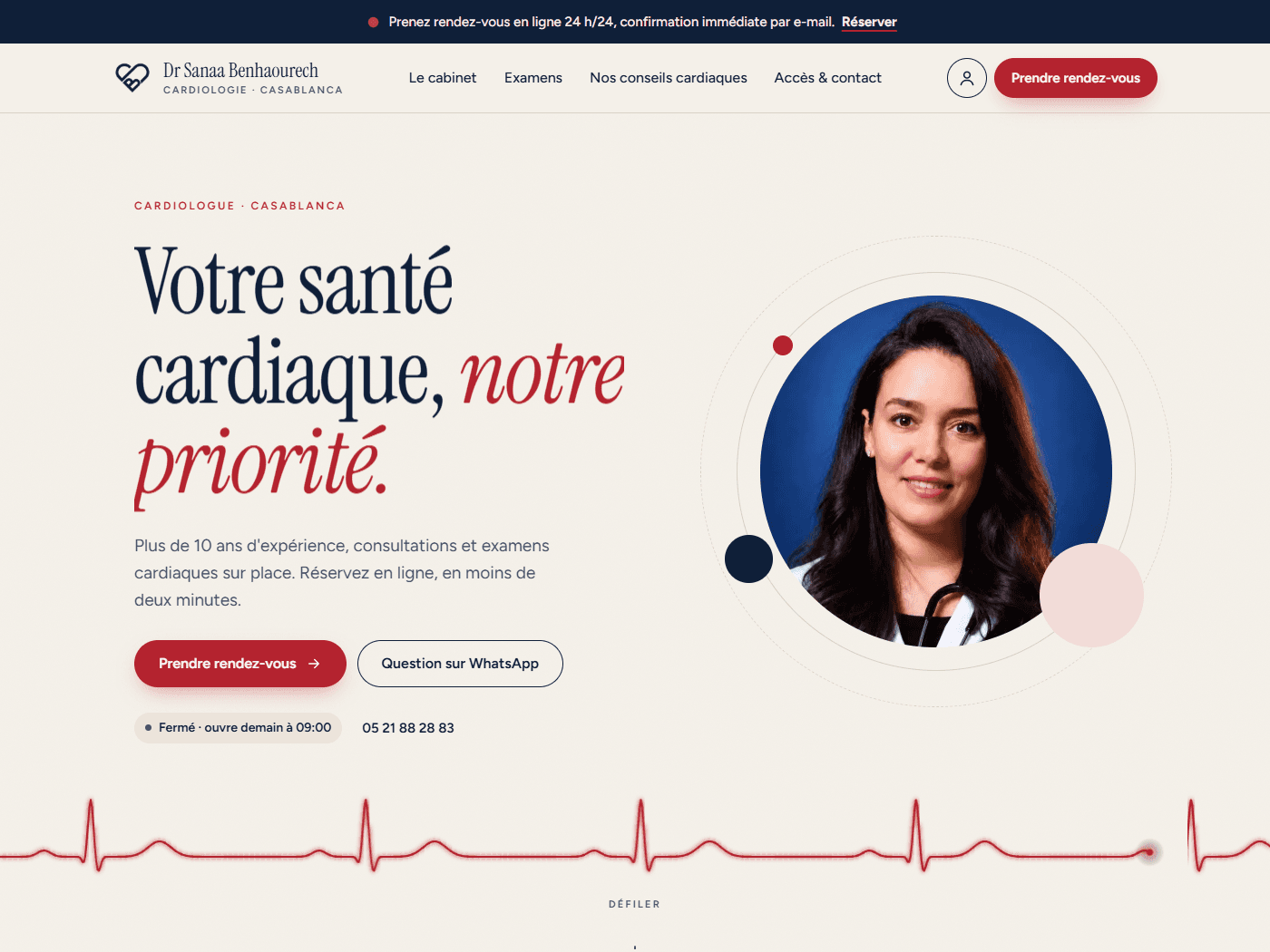
A patient looking for a cardiologist or a dentist almost always does the same thing: types the specialty and the neighbourhood into Google, looks at two or three results, and calls the one that inspires the most confidence. If your practice has no website, or the website does not answer their questions, they call someone else.
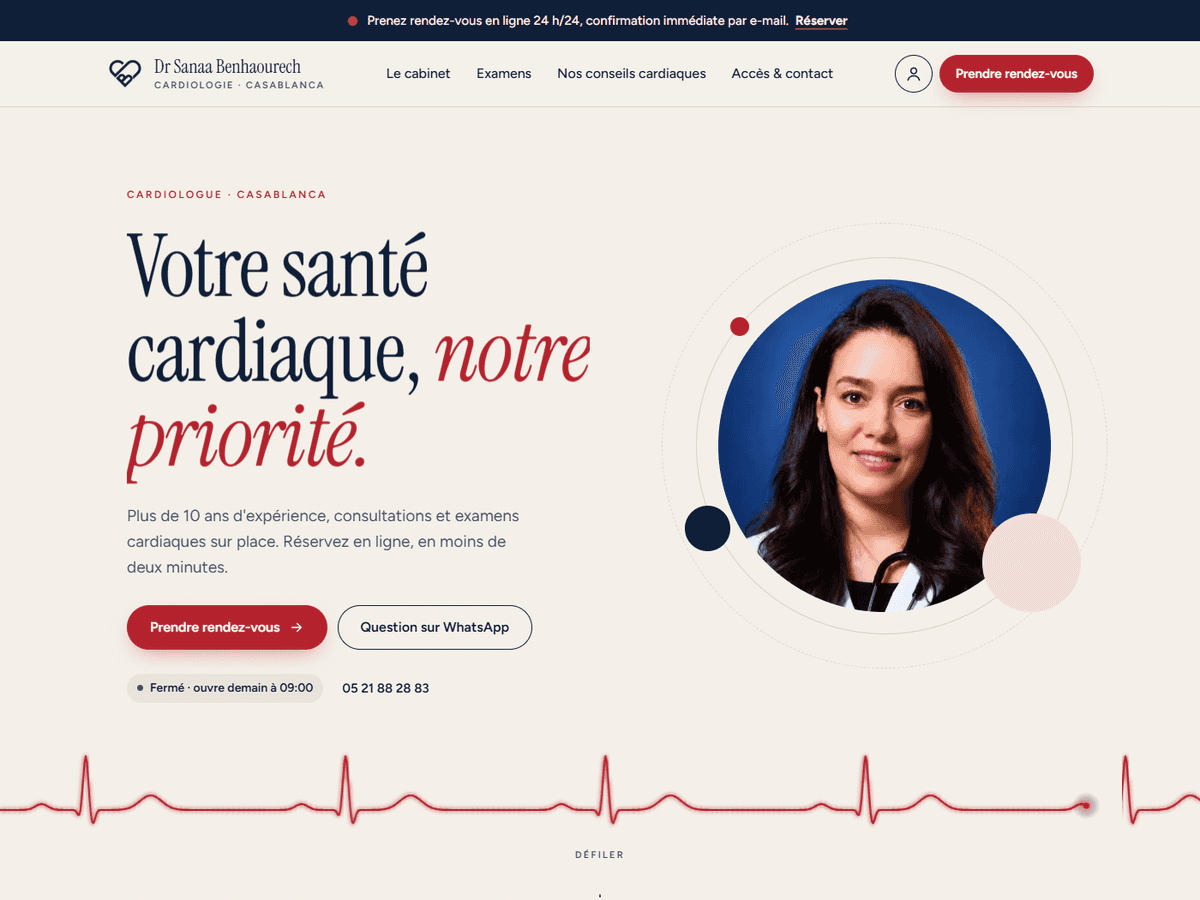
This article describes what a practice website needs to turn that search into an appointment. It is based on two sites I designed and launched in Casablanca: the cardiology practice of Dr Sanaa Benhaourech and Centre dentaire la Nation. It ends with what medical ethics rule out, in Morocco and in France, because a doctor’s website is not a shop.
1. Online booking, up front
This is the action that matters; the rest of the site leads to it. On the cardiology site the patient picks the exam (consultation, echocardiography, ECG, 24-hour Holter, blood pressure Holter), then a slot, and gets a confirmation. It takes under two minutes, from a phone, at 11 pm if need be.
Three details separate a booked appointment from a closed tab:
- The button is everywhere, in the navigation and at the bottom of every page, not only on the home page.
- The exam comes before the calendar. Patients know why they are coming; they do not know how long a Holter takes.
- A safety net: if an exam cannot be booked online, the page shows the phone number instead of an empty calendar.
2. A page per exam or treatment
This is where SEO happens. Patients do not only search “cardiologist Casablanca”; they also search “blood pressure Holter preparation” or “how long does scaling take”. A page per exam answers each of those searches, and each one brings its own visitors from Google.
Every page answers the same questions, in the same order:
- What it is, in one sentence without jargon.
- Why it is prescribed.
- How to prepare (fasting or not, what to bring, what to wear).
- How long it takes.
- Insurance cover (in Morocco, CNSS and CNOPS for instance).
- A button that books this exam, already selected.
3. The answers the phone gives all day
Ask your front desk for the ten questions they hear most. Those are the ten questions of your FAQ. On the cardiology site the contact page has nine: hours, access, parking, insurance, documents to bring, waiting times. Every answer read on the site is one call fewer, and a properly marked-up FAQ can show directly in Google’s results.
4. Trust, without advertising
Patients want to know who will treat them: your training, your degrees, your career, your practice in photos, how a first visit goes. Centre dentaire la Nation walks through that first visit step by step; the cardiology practice presents the doctor’s training, in Casablanca then in Bordeaux. These are facts, and facts are what reassure.
What has no place is anything that reads like an advert. More on that below.
5. Articles that answer patients
Both practices launched with articles: six patient guides for cardiology, ten articles for the dental centre, written from what patients actually type into Google. Each cites its sources, ends with a short FAQ and links to booking. That content is what brings visitors for free, month after month, without ads.
One rule: the doctor reads and approves every article before it goes live. The site speaks in their name.
6. A patient space, if the practice will use it
It is an option, not a requirement. On the cardiology site patients see their upcoming appointments, a preparation checklist and their history. It saves calls, but it demands real care with privacy: secure sign-in, no medical data stored without need.
7. The technical foundations Google reads
- Fast on a phone: most patients arrive on mobile.
- Medical structured data (MedicalClinic, Physician or Dentist, FAQPage) telling Google who you are, where and when.
- A title and description per page, written for the search it targets.
- A sitemap and Search Console, so Google finds every page and you see which searches you appear for.
- An up-to-date Google Business Profile linking to the site. That has its own article.
What medical ethics rule out
A doctor’s website informs; it does not sell. The rules differ by country, and the final word is yours, not your web designer’s; here is what the texts say.
In Morocco, the Code of ethics of the medical profession (decree no. 2-21-225 of 17 June 2021) forbids advertising. It allows a doctor to have a professional website or online space, provided the regional council of the National Order of Doctors is informed. So before launch, tell your regional council.
In France, since decree no. 2020-1662 of 22 December 2020, article R.4127-19-1 of the public health code lets doctors give the public information that helps them choose a practitioner, including on a website. It must be fair and honest, must not use third-party testimonials, must not rest on comparisons with other doctors, and must not mislead.
On the site, in practice, that rules out:
- patient testimonials and reviews displayed on the site;
- comparisons (“the best cardiologist in Casablanca”);
- promises of results, before/after pictures presented as a guarantee;
- promotions, discounts and anything that treats care as a product.
To be clear: I am not a lawyer. The texts above are those in force on the date of this article; your Order’s council remains the reference, and the place to ask when in doubt.
In short
- Online booking, visible everywhere, exam first.
- A page per exam or treatment, each written for a real search.
- An FAQ made of the questions your front desk hears every day.
- Facts that reassure: training, practice, how a visit goes.
- Articles approved by the doctor.
- Clean technical foundations and an up-to-date Google listing.
- No advertising, no testimonials, no comparisons.
What next?
Want a site like these for your practice?
I design, build and rank everything described here. See websites for doctors, or send me your current site: within a day you get the three things I would change first.

Hamza BenjaabaI design and build websites that sell, and the Google SEO that brings them visitors, for brands, doctors and freelancers. Both practices mentioned here are projects I delivered, and they are live.
How it works
From one link to a site that brings clients.
One link and one line on what isn't working. No call needed to start.
Within 24 hours: the three things I would change first, the scope, the timeline and a price.
New pages around the action you want, a clickable version to test, then development.
Online, Search Console set up, Google Business linked, and the first pages written for real searches.