Freelancers
A freelance portfolio website that wins clients: six things to put on it, in this order
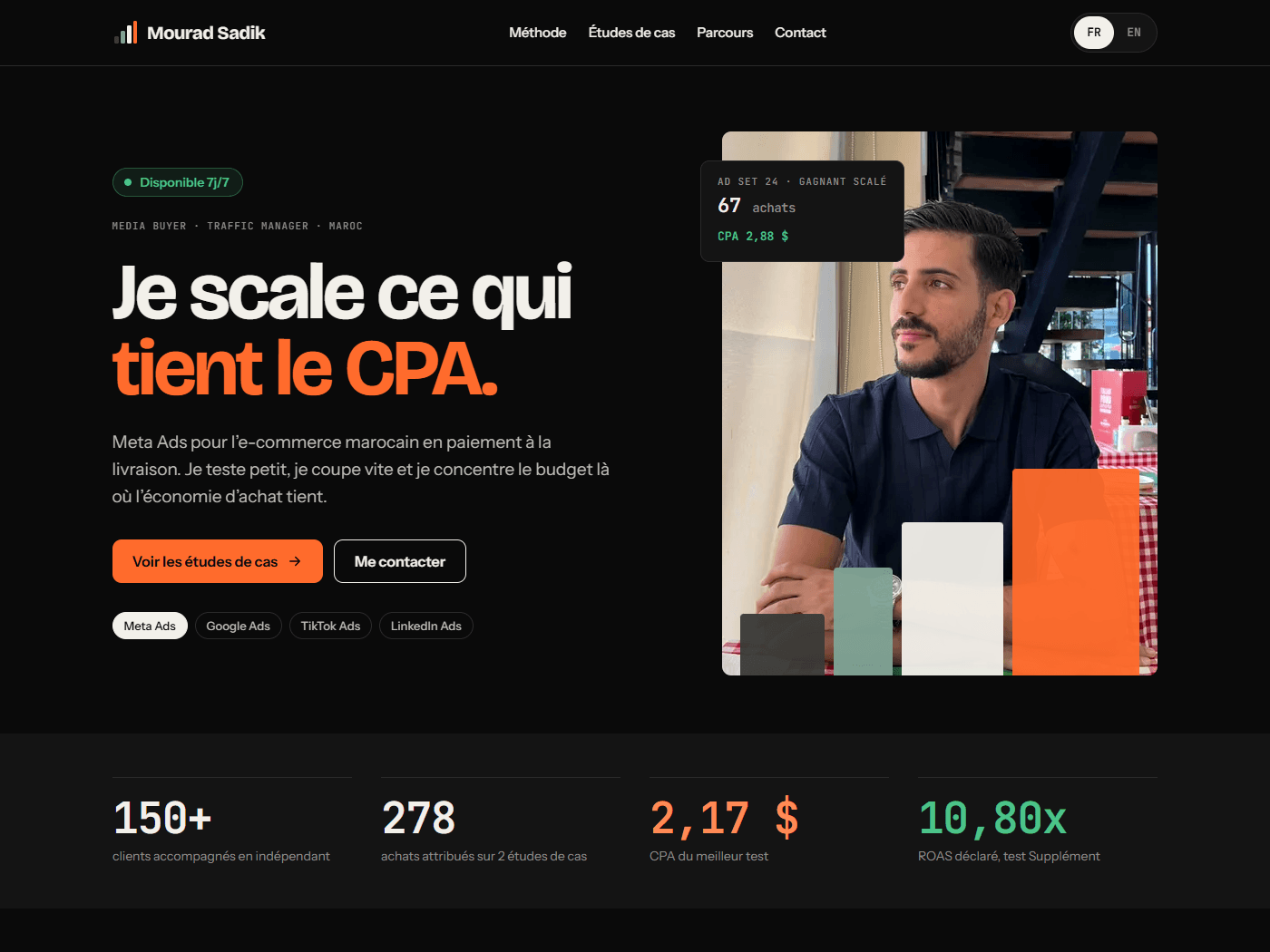
A skilled freelancer nearly always has the same problem: the proof is everywhere except in one place. Results in a PDF, dashboard screenshots on a phone, thank-yous in DMs. The prospect who wants to check before writing finds a social profile or a marketplace page, next to twenty competitors.
That was exactly the situation of Mourad Sadik, a Meta Ads media buyer for Moroccan cash-on-delivery stores. His results existed, as screenshots and PDFs. I turned them into a bilingual portfolio where the numbers lead. Here are its six blocks, in the order a prospect reads them.
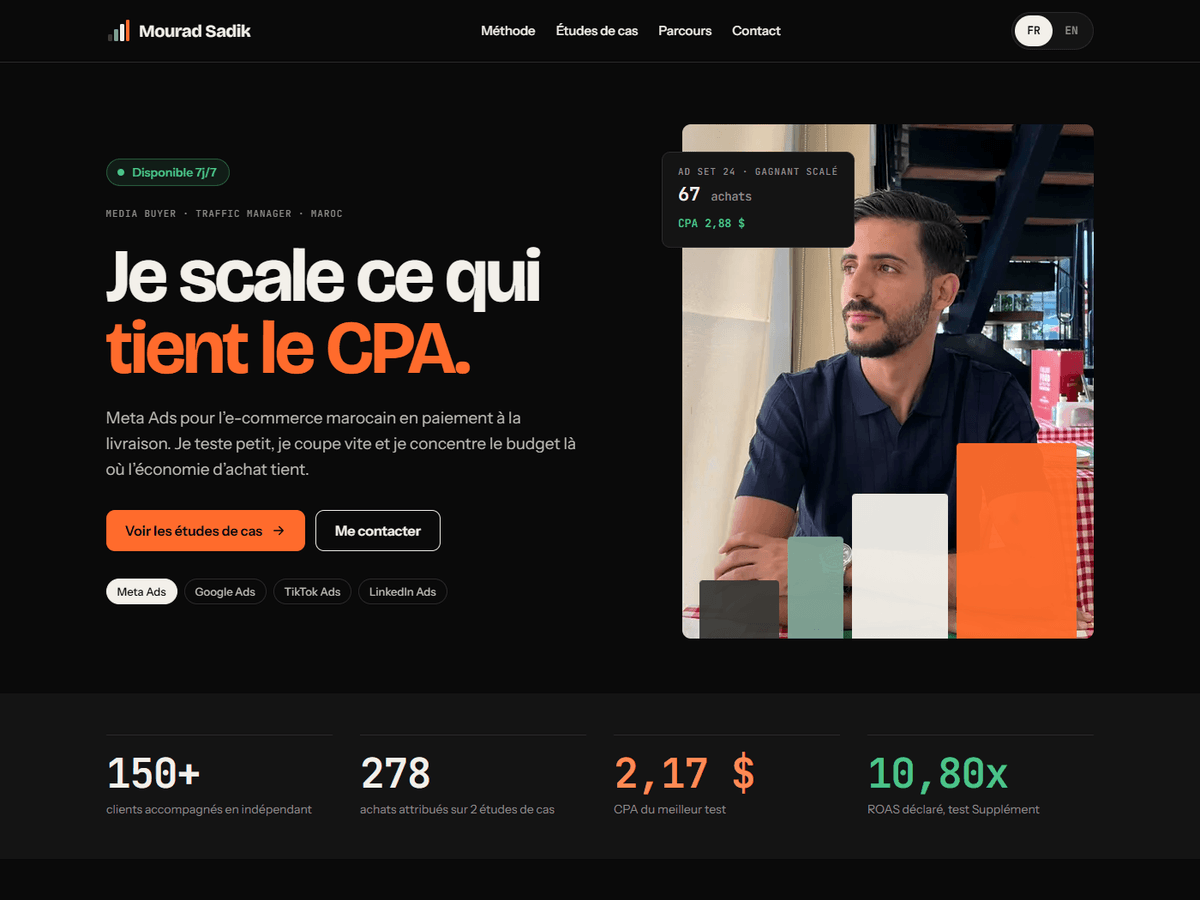
1. A first screen that says what, for whom, with what result
Not “Welcome to my portfolio”, not “Passionate about digital”. One sentence answering the visitor’s only question: does this person do what I need, for someone like me? “Meta Ads media buyer for cash-on-delivery e-commerce” sorts visitors in three seconds: the right ones stay, the others leave, and that is fine.
2. Numbers first
If your work produces measurable results, put them up front, with context. A number without context proves nothing; “this result, for this kind of client, over this period” proves a lot. On Mourad’s portfolio the numbers come from his own campaign data, and they count up as they scroll into view to draw the eye to what matters.
One rule: only show numbers you can back up if asked. A serious prospect will ask.
3. Two or three case studies, told in three beats
Not ten projects skimmed: two or three told properly. Each in three beats: the client’s problem, what you did, what changed. Written for the person paying, not for your peers: no unexplained jargon.
Mourad had two detailed studies, a clothing store and a supplements store. They are told on the site, and downloadable as PDFs in French and English, for the prospect who wants to forward them to a partner. That detail matters: buying decisions are rarely made alone.
4. The method
After the proof, the prospect wonders: how will this go with me? A method page answers in a few concrete steps. It reassures, and it sets you apart from those who promise results without saying how.
5. Experience, and availability
Your experience as a short timeline: where you worked, on what, for how long. Then something almost nobody shows: are you available? Mourad works seven days a week; the site says so on the first screen, on the experience page and on contact. A prospect in a hurry does not write to someone who may not be able to take them on.
6. One obvious action
“Contact me” with no context does not work: the prospect does not know what to write, so they do not write. Give them a frame: a short form asking for the three things you need, a pre-filled message, or a booking link. One main action, repeated at the bottom of every page.
And so Google finds you by name
The first search a prospect who heard of you makes is your name. The next is your trade and your city. Four things make your site come up, rather than a directory:
- A domain in your name, rather than a platform address.
- A “First Last · Trade” page title on the home page, and a proper title on every page.
- “Person” structured data linking your site to your LinkedIn and other profiles.
- A page per service, and if you work in two languages, two versions linked together so Google shows each visitor the right one.
This site is built exactly that way. It is probably how you are reading this.
In short
- A first screen: what, for whom, what result.
- Numbers first, with context.
- Two or three case studies in three beats, downloadable.
- The method, in concrete steps.
- Experience and availability.
- One obvious action, repeated.
What next?
Your proof deserves a site of its own.
I design, build and rank sites for freelancers and consultants. See websites for freelancers, or send me what you have today: within a day you get what I would do first.

Hamza BenjaabaI design and build websites that sell, and the Google SEO that brings them visitors, for brands, doctors and freelancers. The portfolio mentioned here is a project I delivered, and it is live.
How it works
From one link to a site that brings clients.
One link and one line on what isn't working. No call needed to start.
Within 24 hours: the three things I would change first, the scope, the timeline and a price.
New pages around the action you want, a clickable version to test, then development.
Online, Search Console set up, Google Business linked, and the first pages written for real searches.